How and why has the description of Extraterrestrials changed over time?
When we think of Extraterrestrials, many things come to mind: something unknown and intriguing, scenes from movies we’ve seen, or the possibility that we are not alone in the universe. Some think of the benevolent creature E.T. and friendly contact, others of movie invasions and battles, and still others of stories about alleged abductions and experiments.
This is precisely why it’s important to understand how this collective image was formed and who influenced it the most. It didn’t emerge all at once, nor was it the same from the beginning. The development of this image is described in detail by Gerard Aartsen in his 2017 book Before Disclosure 1.
Positive Messages in the 1950s
If we look at the beginnings of modern reporting on Extraterrestrials, particularly the 1950s, we can see something very clear: the first known contactees – that is, Earthlings with whom Extraterrestrials established contact, conveyed specific messages to, and even invited onto their spacecraft – did not bring messages of terror, but rather positive messages of encouragement and broader responsibility.
George Adamski, Daniel Fry, Howard Menger, Buck Nelson, and other contactees reported receiving messages from Extraterrestrials. Most of the messages emphasized the need for humanity to change its behavior. After receiving the messages, they shared them with the public, along with additional documentation in some cases (e.g., photographs). They warned that humanity’s misguided actions lead to wars, particularly highlighting the danger of nuclear war. The messages spoke of the need for cooperation among nations, the urgency of social justice, and the fact that humanity is advancing technologically faster than it is maturing morally. This is a characteristic of the early reports about Extraterrestrials. They made no mention of abductions; instead, they emphasized peace, cosmic brotherhood, and collective responsibility.
George Adamski also said that the visitors would gladly share the advanced knowledge that allows them, for example, to overcome gravity, but the extraterrestrial visitors’ position was that humanity had not yet learned to live “in peace and brotherhood” for the benefit of all. If such knowledge – and consequently such power – were given too soon, it would be used for armament and the conquest of other worlds. In their view, humanity at this stage does not need more advanced technology, but rather greater ethical maturity. 2
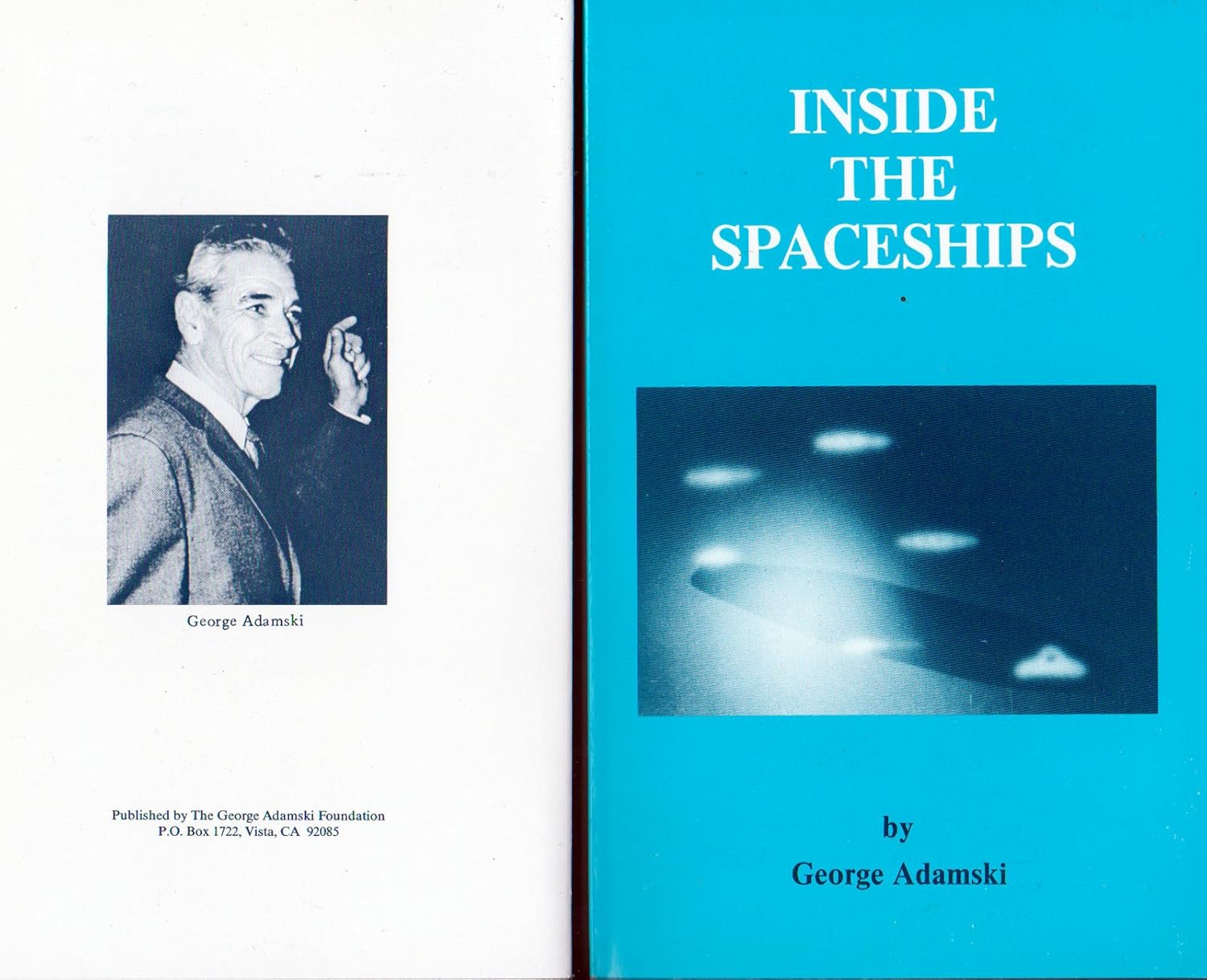
George Adamski and his second book, Inside the Spaceships, source: Amazon
In this spirit, it was also conveyed to Adamski that humans must understand that they are »one with all of creation« and that »there is no separation except that which they create themselves.« 3 Daniel Fry wrote similarly, based on conversations with Extraterrestrials – that the needs, hopes, and fears of all people are fundamentally the same, and that only when everyone recognizes this shared humanity will the One World we like to speak of be possible! 4
The Beginnings of Disinformation During the Cold War
These early messages were compelling enough to reach a wider audience. At the same time, however, they were also unwelcome to the political forces that shaped the Cold War era. If someone says that humanity’s future depends on cooperation, sharing, peace, and an end to the arms race, that is not a welcome message for those forces that are simultaneously trying to mobilize the public for ideological and military conflict.
That is why, during the same period, these political forces also began spreading disinformation and portraying Extraterrestrials as a threat. One after another, movies such as Invaders from Mars (1953), Earth vs. the Flying Saucers (1956), and Invasion of the Saucer Men (1957) hit the big screen, which contributed significantly to the invasion narrative. In 1959, the editors of Flying Saucer Review protested against the trend of using movies and other media to instill fear of spaceships and Extraterrestrials in the global public. 5
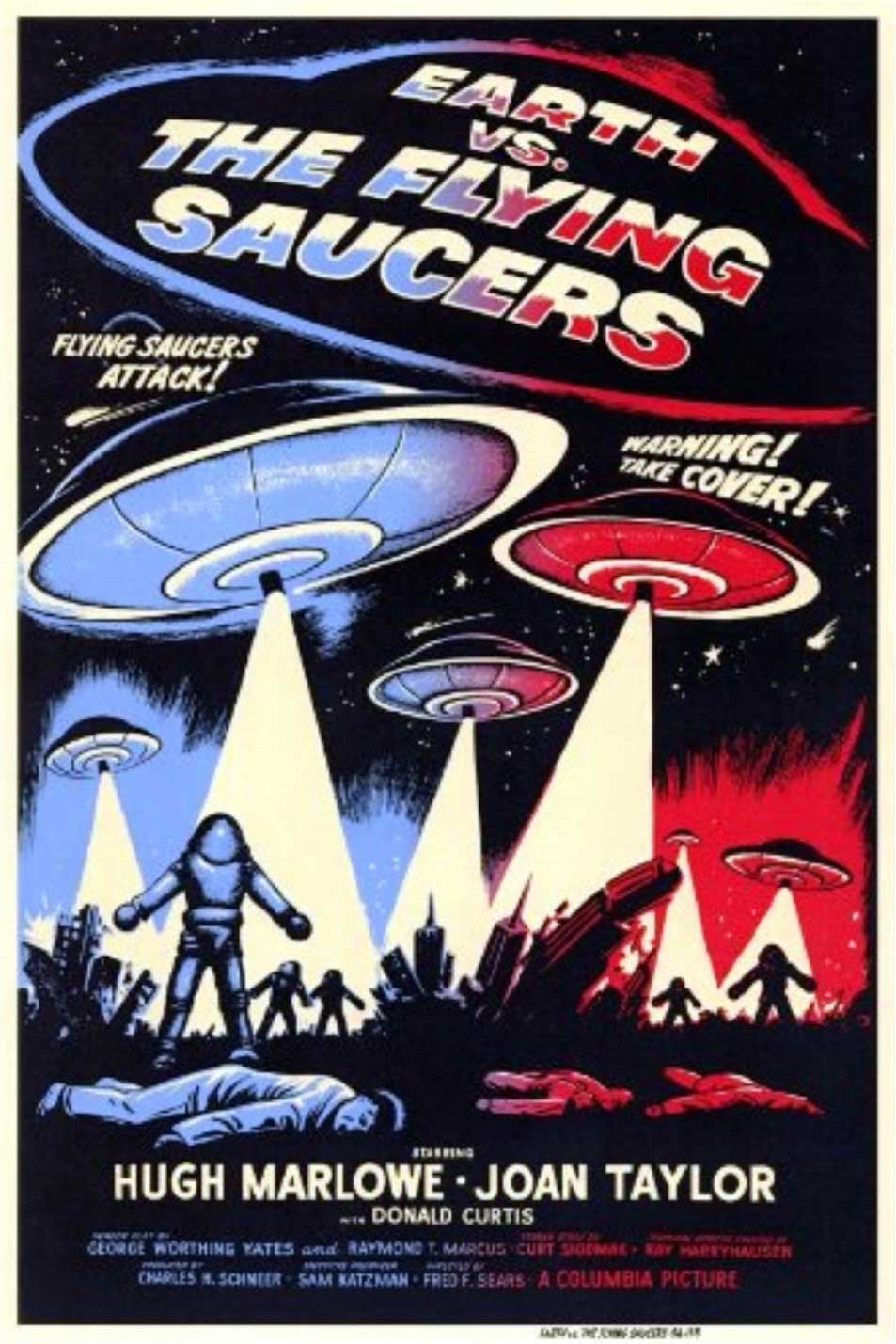
Poster advertising the movie: Earth vs. the Flying Saucers, source: IMDB
The 1961 case of Betty and Barney Hill is today generally cited as the first widely publicized case of an alleged abduction and decisively shaped the subsequent abduction genre. The narrative of Extraterrestrials as abductors thus emerged after a period during which images of external threats had been presented to the public for several years. 6
This does not mean that all witnesses lied when describing their experiences. Their experiences must be understood within a broader psychological and cultural context. Scientific literature points out that sleep paralysis, hypnopompic hallucinations, suggestion, hypnosis, and the effects of certain drugs can create experiences that are subjectively real to the individual but are not connected to an external event. In the case of Betty Hill, psychiatrist Benjamin Simon expressed his opinion that, in his view, the couple were not lying and were sincere; however, he found it plausible that Betty had dreamed the abduction, as she had written down a dream with similar details after the event, and her husband Barney had accepted her story as true. 6 Even the Encyclopædia Britannica notes that hypnosis and guided imagery can reinforce or create false memories. This may explain why, once the abduction narrative became established, more such reports began to surface. 7
More recent official and journalistic investigations in the U.S. also confirm that the government itself has obscured the topic of UFOs for decades. Although the Pentagon’s AARO office dismissed allegations of concealing extraterrestrial technology in its 2024 historical review, investigations and subsequent reporting have revealed that military entities have, on occasion, disseminated or permitted deceptive narratives to safeguard classified programs and divert attention. 8
Logical Arguments for the High Ethics of Extraterrestrials
The strongest argument against labeling Extraterrestrials as violent abductors is of a logical nature. If a civilization is capable of traveling interplanetary or even interstellar distances, altering the visibility of its craft, and performing maneuvers beyond our civilization’s comprehension, then it is scientifically and technologically far ahead of us. Astronaut Edgar Mitchell commented that if this civilization were hostile, »we would have been gone long ago, as we would have no defense against it.« 9 Robert Salas, retired US Air Force captain, expressed the same logic regarding UFOs over nuclear bases: »… if they wanted to destroy us, they could easily do so.« 1 At a congressional hearing, he also emphasized that these are peaceful beings and that they had neutralized 10 nuclear warheads at a U.S. Air Force base in Montana. 10
Adamski warned that the power of these beings far exceeds our weapons and that, if they were hostile, this would have become evident long ago. Desmond Leslie, Adamski’s coauthor on the book Flying Saucers Have Landed, also wrote in 1955 that if some hostile power had possessed such technology for decades, it could have conquered the world practically overnight. 11 Nothing of the sort has happened. This simple conclusion remains powerful to this day: a long-term presence coupled with obvious technological superiority speaks to restraint and a willingness to help, not aggression.
Various sources also contain encouraging statements by public figures and dignitaries who did not view Extraterrestrials through the lens of terrifying otherness, but rather through the lens of kinship and humanity. Pope John XXIII (1881–1963) said to his assistant, who had also observed an unknown craft landing in the garden of the Castel Gandolfo residence and then watched as the pope spoke for 20 minutes with a being from the craft: “God’s children are everywhere. Sometimes it is difficult to recognize our own brothers.” 12

John XXIII, the pope who spoke with an Extraterrestrial in 1961 and described him as a child of God, our brother. Source: Diario Popular
Kirsan Ilyumzhinov (Russian politician, longtime president of FIDE, and former president of Kalmykia), Alberto Perego (Italian diplomat and consul), Bruno Ghibaudi (an Italian journalist, columnist, and contributor to the Rai media group), and several other well-known figures have spoken about the kinship between humans and Extraterrestrials, whom they described as beings very similar to us (differences lie at most in height, skin color, and eye color), but with a higher degree of wisdom.
Another important aspect that reinforces the positive image of Extraterrestrials and their high ethical standards is that they do not impose their existence and presence. Enrique Barrios, a contactee from Chile, received information that open mass contact would not be humane, as it would cause collective shock, and some might even die from the shock – due to the images they had formed through scary movies or stories. 13
Wilbert Smith, a Canadian engineer and contactee, similarly shared that such a broader encounter will occur freely and openly only when humanity is sufficiently prepared to accept it »on a common foundation of mutual understanding and trust.« This is a lofty yet sensible contact ethic: a more advanced civilization does not wish to interfere with humanity’s evolution, but rather respects its free will and its pace of maturation. 14
A Vision for Human Civilization
So which image of Extraterrestrials should modern civilization embrace? The image of an aggressor that reflects our own conflicts, laboratories conducting animal experiments, and a logic of control? Or the image of a more advanced civilization that understands the need for harmonious, holistic development – both ethical and technological? And one that wishes to help us in this critical time, when humanity stands at a crossroads. At this crossroads, one path leads to further conflict, competition, division, armament, social fragmentation, and self-destruction. The other path leads to cooperation, sharing, a more just world, and shared development.
All of this prompts us to consider that merely recording UFOs may not be enough to truly prepare our civilization for contact with Extraterrestrials. The challenge is greater. Will we, as humanity, be ready and able to live in harmony without resorting to nuclear self-destruction or viewing everything that is unknown as an enemy? The question of Extraterrestrials is also a question about ourselves.
Read more about arguments for the existence of Extraterrestrials and their various forms of contact throughout history in the feature article: Is it possible that beings from other planets want to establish contact with us? The evidence confirms this.
Sources:
- Gerard Aartsen, Before Disclosure: Dispelling the Fog of Speculation, revised edition (2017).
- George Adamski, Inside the Space Ships (1955).
- George Adamski, Telepathy: The Cosmic or Universal Language, Part II (1958).
- Daniel Fry, The White Sands Incident (1966).
- Special Editorial, ‘Why This Horror From Space Trend?’, Flying Saucer Review, Vol. 5, No. 2 (March–April 1959).
- HISTORY, ‘How Betty and Barney Hill’s Alien Abduction Story Defined the Genre’, Web Archive (2020): https://web.archive.org/web/20230708012841/https://www.history.com/news/first-alien-abduction-account-barney-betty-hill
- Britannica Editors, False Memory Syndrome, Encyclopedia Britannica (April 2024): https://www.britannica.com/science/false-memory-syndrome
- AARO, Report on the Historical Record of U.S. Government Involvement with UAP, Vol. I (February 2024): https://media.defense.gov/2024/Mar/08/2003409233/-1/-1/0/DOPSR-2024-0263-AARO-HISTORICAL-RECORD-REPORT-VOLUME-1-2024.PDF
- Interview with Dr. Edgar Mitchell on Nick Margerrison’s The Night Before, Kerrang! Radio, UK (July 2008).
- Yahoo News, ‘WTF’: Retired USAF captain recalls UFO encounter, says aliens turned off 10 nukes (November 2024): https://www.yahoo.com/news/wtf-retired-usaf-captain-recalls-234440482.html
- Desmond Leslie, ‘Astronomy and Space-Men’, Flying Saucer Review, Vol. 1, No. 3 (July–August 1955).
- John XXIII, the Pope Who Spoke with an Alien (Juan XXIII, el papa que habló con un extraterrestre), Diario Popular, (April 2014): https://www.diariopopular.com.ar/juan-xxiii-el-papa-que-hablo-un-extraterrestre-n190069
- Enrique Barrios, Ami – Child of the Stars (1989).
- Wilbert Smith, ‘The Philosophy of the Saucers’, Flying Saucer Review, Vol. 4, No. 3, May–June 1958.