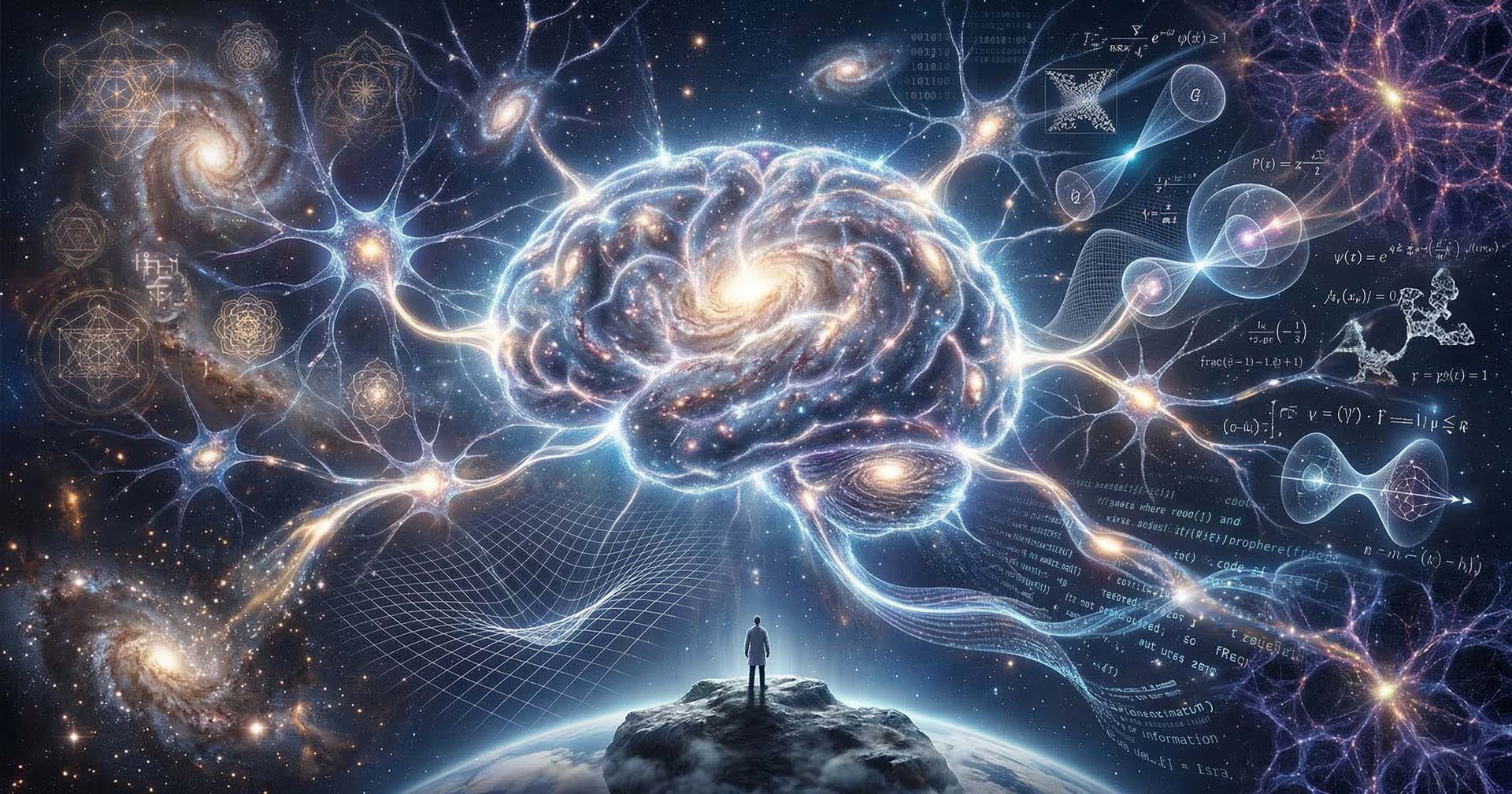
In recent times, a growing view has been gaining ground: intelligence is not merely a capacity of complex brains but a fundamental property of the universe itself. While various traditions have long spoken of this, and many people intuitively sense it, this understanding is now gradually entering the domain of science as well. Before our very eyes, a more holistic – and in its own way surprising – new image of our existence is beginning to take shape.
Three perspectives on the nature of reality
We thus (finally) find ourselves entering a discussion of three different perspectives on the nature of reality:
- Reality as a mechanical system: nature functions like a machine, without intrinsic intelligence.
- Reality as a system in which intelligence is emergent: intelligence arises as a property of sufficient complexity; it develops spontaneously in adequately complex systems.
- Reality as a system in which intelligence is fundamental: intelligence is a basic characteristic of the universe itself.
The evolving view of intelligence in the cosmos
Modern science recognizes various fundamental constituents of the universe: space, time (often unified as spacetime), energy (including mass), diverse fields and their interactions, and, more recently, information. This view has developed gradually, guiding scientific progress over centuries, reaching a peak with Einstein’s theory of relativity and its radically new conception of spacetime, the discoveries of quantum mechanics, and the emergence of information theory.
At the forefront of this wave of insight, a realization is beginning to take shape among contemporary thinkers: another element may need to be added to this list – intelligence. This bold idea arises from growing evidence that intelligence manifests at different levels of complexity – from individual cells to entire organisms, and perhaps even beyond. One may recall how astronomers sometimes compare the distribution of intergalactic matter to the structure of the human brain.
Comparison between neural and cosmic network
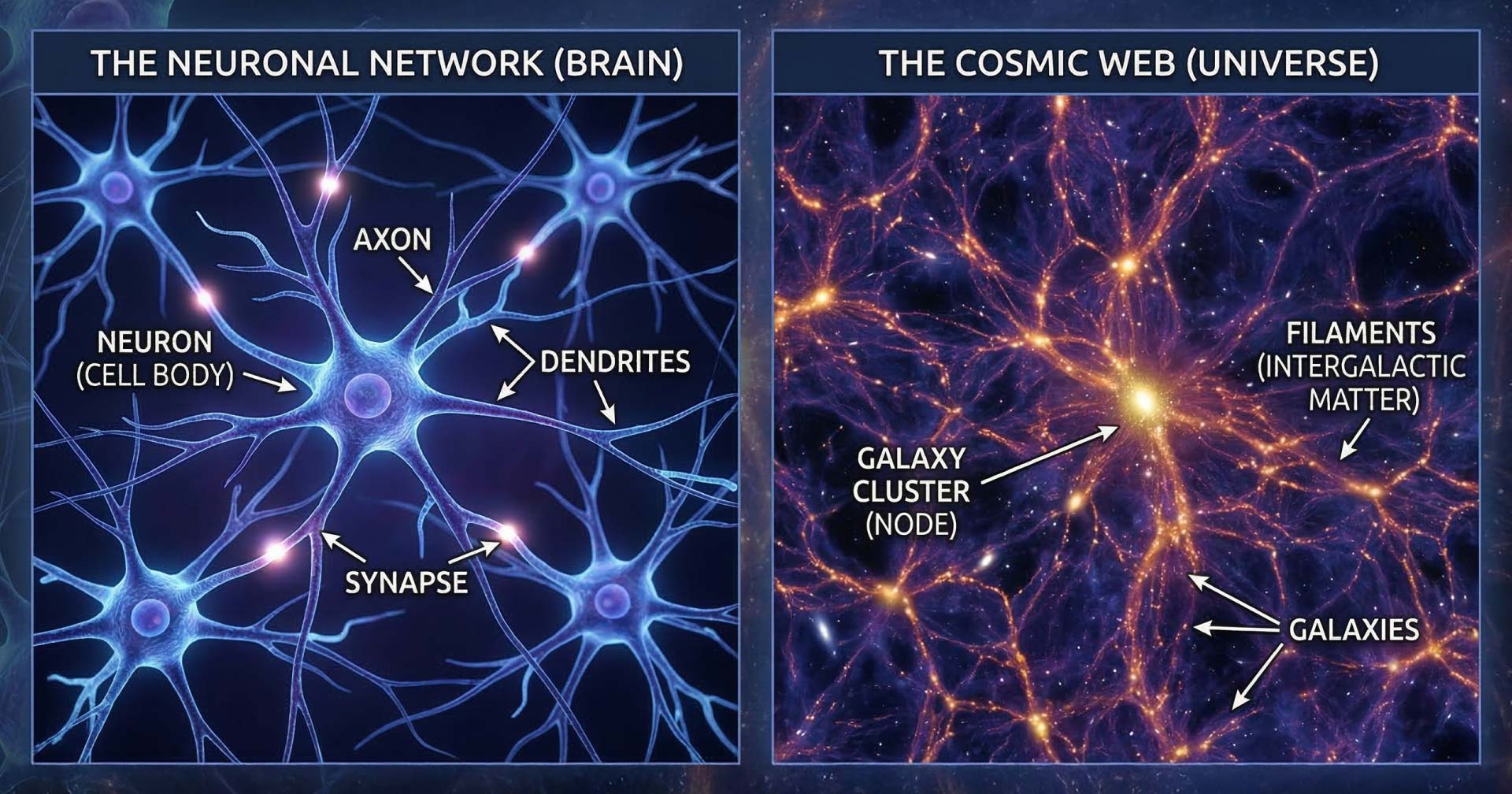
A complex network of neural cells that connect via branched endrites and long axons.
Large-fluent fibers of dark matter and gases connecting the flocks of galaxies
Beyond emergence: Intelligence as a primary property of the cosmos
Historically, philosophical traditions before Galileo did not mostly view nature as a mechanical system. Rather, it was often understood as permeated by some form of intelligence or rational principle. Philosophers such as Anaxagoras introduced the idea of nous – mind or intelligence – as a cosmic force that orders matter.
In the eighteenth and early nineteenth centuries, both scientists and philosophers tended to regard intelligence either as a unique feature of life or as an emergent property of sufficiently complex and organized systems, such as animal brains. Just as the principle of intelligence faded from physics after Galileo, it underwent a similar eclipse in biology following Darwin.
Today, however, insights into the intelligent organization of matter are emerging even at the molecular level. If we consider intelligence as a fundamental property of the universe, we may draw an analogy with potential energy: just as potential energy exists in a latent (unexpressed) state and becomes kinetic (active) under appropriate conditions, so too intelligence may remain a potential until material and energetic circumstances allow it to manifest. As an intrinsic property of the “fabric” of the cosmos, intelligence requires only the appropriate systemic organization – the structuring of matter and energy – to express itself. Naturally, it manifests only to the extent that such structures permit. At the same time, once sufficiently expressed, intelligence may begin to transform and evolve the very structures through which it operates. In the living world, we thus witness the development of species from primordial bacteria (often referred to as LUCA) to human beings.
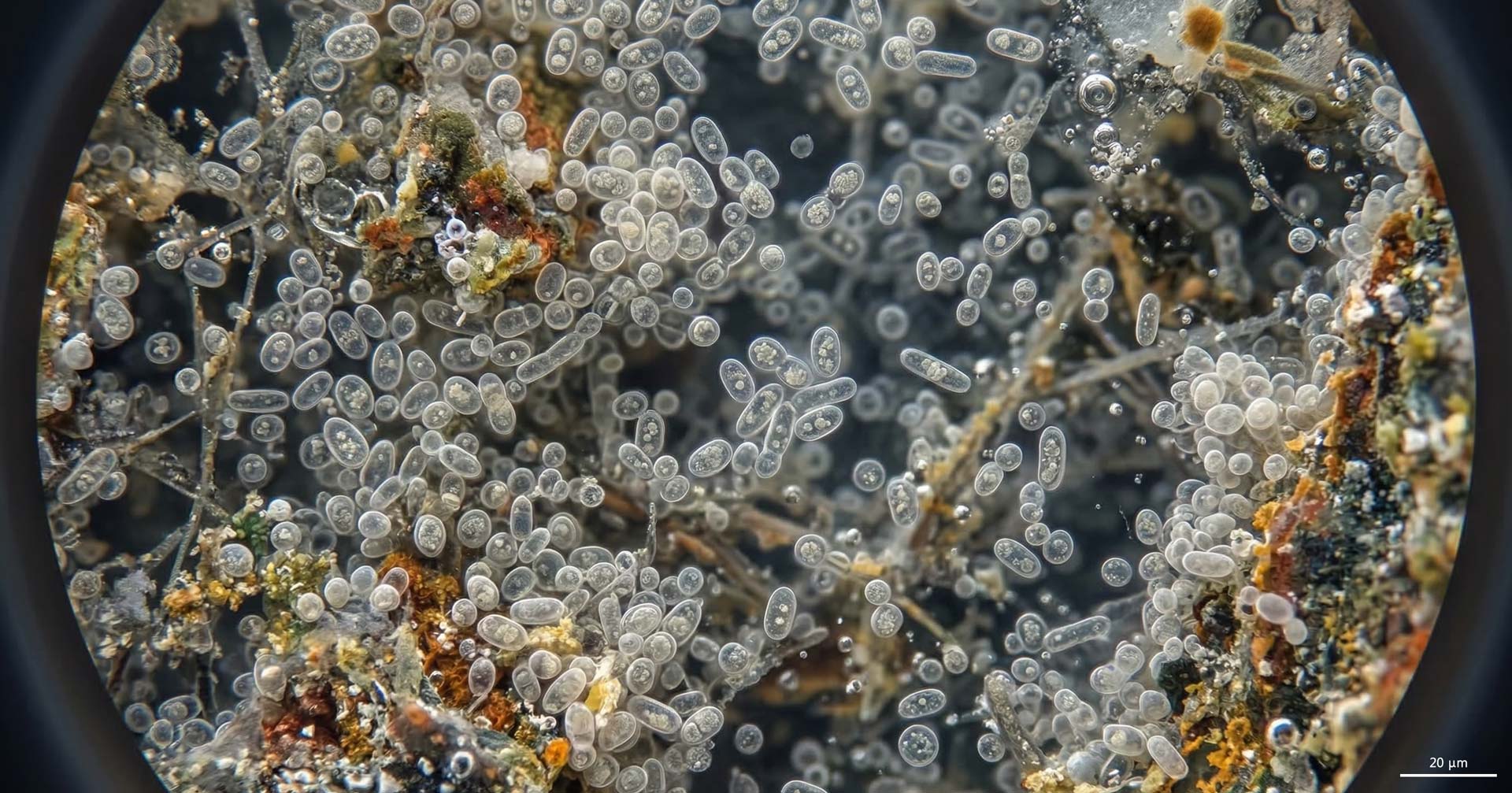
LUCA – the last common ancestor of all living
Arguments for intelligence as a universal principle
As noted, a growing number of examples in contemporary science reveal adaptive and goal-directed behavior in unexpected contexts, challenging the prevailing assumption (or dogma) that intelligence arises only at high levels of organized complexity.
For instance, slime molds solve artificially constructed mazes by finding the most efficient path to a food source—a clear demonstration of problem-solving, despite the absence of a central nervous system. Similarly, single-celled organisms, freely existing molecular assemblies within cells, and even relatively simple molecules (such as obelisks) exhibit forms of decision-making, adaptability, and even reproduction, strongly suggesting that intelligence is present at a fundamental level of the universe.
At higher biological levels, social insects such as ants and bees organize complex collective behaviors, giving rise to a new, “swarm” intelligence that exceeds the capacities of individual members. At the human level, the complexity of our own thinking, creativity, and technological achievements further confirms intelligence as a transformative force.
In line with many spiritual and philosophical traditions, these and numerous other examples may be understood not merely as biochemical phenomena or exceptional emergent effects, but as expressions of a deeper universal principle in which intelligence is woven into the very fabric of reality.
How a new understanding of intelligence may transform our view of the world
Viewing intelligence as a fundamental property of the cosmos challenges many key assumptions in science and philosophy.
A new definition of cognition emerges: where do we draw the boundary of knowing and awareness? If intelligence permeates reality, then any sufficiently complex system may begin to display intelligent behavior.
Cosmological and biological models are re-evaluated: learning, adaptation, and problem-solving may not be limited to highly developed organisms but may instead be intrinsic to the very substance of the universe, including so-called quantum foam or vacuum fluctuations.
It encourages interdisciplinary research: linking physics, biology, cognitive science, philosophy, and spirituality may lead to a renewed and expanded understanding of reality.
Ethics as a natural consequence: if intelligence permeates nature and is not confined to humans, this calls for a transformed relationship with the environment. Nature is no longer passive, devoid of awareness or intelligence; rather, it becomes something living and responsive, perhaps even capable of communication. Such an insight calls for an expansion of contemporary ethical principles. Nature is no longer merely a resource for exploitation, but becomes a presence to be respected, engaged with, and lived in harmony with.
The end of the dead universe: the emergence of a living intelligence
Together with some contemporary thinkers, we may thus place intelligence alongside space, time, energy, and information – opening the door to a new perspective. The universe is no longer merely a purposeless mechanism, but a dynamic, intelligent process. Likewise, intelligence is not simply an emergent phenomenon, but one of the primary characteristics of existence itself.
Although much research remains to clarify its nature, laws, mechanisms, and modes of manifestation across different levels of complexity, the implications of this view are profound and far-reaching. A new dimension of collective inquiry into the nature of being and the purpose of existence is opening before us – one that offers a shift to a higher level of understanding: we are not accidental passengers in an indifferent universe, but active participants in a deeply intelligent process that transcends our previous assumptions about nature and life.